RIDGE CONCRETE KALAMUNDA
08 6834 7459
Concrete Driveways in Kalamunda
Did you know that a poorly graded concrete driveway is one of the leading causes of garage flooding and edge cracking in hill properties across Kalamunda?
A driveway takes more daily weight and wear than almost any other surface on your property. When you park heavy vehicles day in and day out, the underlying base determines whether your surface remains crack-free or starts sinking within a few seasons.
We pour engineered driveways built to withstand local soil conditions and daily vehicular traffic. Every project is planned with precision, ensuring your home gains an attractive, long-lasting entrance that handles the elements without hassle.

Engineered Driveway Pouring for Kalamunda Conditions
Soil movement and sloped terrain require careful preparation before any concrete trucks arrive. Kalamunda and surrounding hill suburbs feature clay-heavy ground that expands and contracts with changing moisture levels. Without deep excavation, compacted crushed rock, and steel reinforcement mesh, standard poured concrete can quickly buckle under these shifting forces.
As an experienced driveway contractor, we start every job by clearing soft topsoil down to a stable base. We then lay down a sub-base layer, compacting it thoroughly to create an even, high-load platform.
Proper base preparation ensures weight spreads evenly across the entire surface, preventing soft spots that lead to cracking or uneven settling. If you are planning a matching outdoor living space at the same time, we can also lay down a new concrete patio that seamlessly connects your driveway to your outdoor living area.
Choosing the Right Surface Finish for Your Home
A new driveway needs to perform well, but it should also complement the architectural style of your home. We offer several finishes tailored for durability and slip resistance:
A new driveway needs to perform well, but it should also complement the architectural style of your home. We offer several finishes tailored for durability and slip resistance:
- Exposed Aggregate: Ideal for sloping ground. By removing the top layer of cement paste, the naturally coloured stones and pebbles inside the concrete mix are exposed. This creates a textured surface that provides excellent traction underfoot and under vehicle tyres.
- Liquid Limestone: Remains cooler under direct sunlight during warm summers, providing a smooth yet textured natural stone appearance.
- Broom Finish Plain Concrete: A practical, cost-effective option that uses broom texturing to supply reliable grip in wet weather.
- Coloured Concrete: Pigment is mixed directly into the batch, giving you an even shade throughout the full depth of the slab rather than just a surface coating.
Working as a local concrete company, we guide you through selecting the right textures and colours for your site conditions. If your current driveway is structural and intact but looks stained or weathered, complete removal is not always necessary. In many cases, professional concrete resurfacing can restore the top surface at a fraction of the cost of a full teardown.
The Complete Driveway Installation Process
Pouring a high-performance driveway requires a clean sequence of trade steps. Shortcuts during early site work almost always show up as surface defects later on.
- Site Survey & Excavation: We assess slope lines, measure the area, and excavate the ground to the depth required for sub-base aggregate and concrete.
- Formwork & Steel Reinforcement: We install heavy-duty timber forms along the perimeter and lay steel reinforcing mesh elevated on chairs so it sits in the middle of the pour.
- Establishing Drainage Falls: We calculate precise slope angles to direct rainwater runoff away from garage openings, home foundations, and neighbouring boundary lines.
- Pouring & Finishing: The residential concrete mix is placed, screeded flat, floated, and hand-finished with your chosen surface texture.
- Control Joints & Curing: Expansion joints are saw-cut into the slab at calculated intervals to control natural expansion and contraction, preventing random surface cracking.
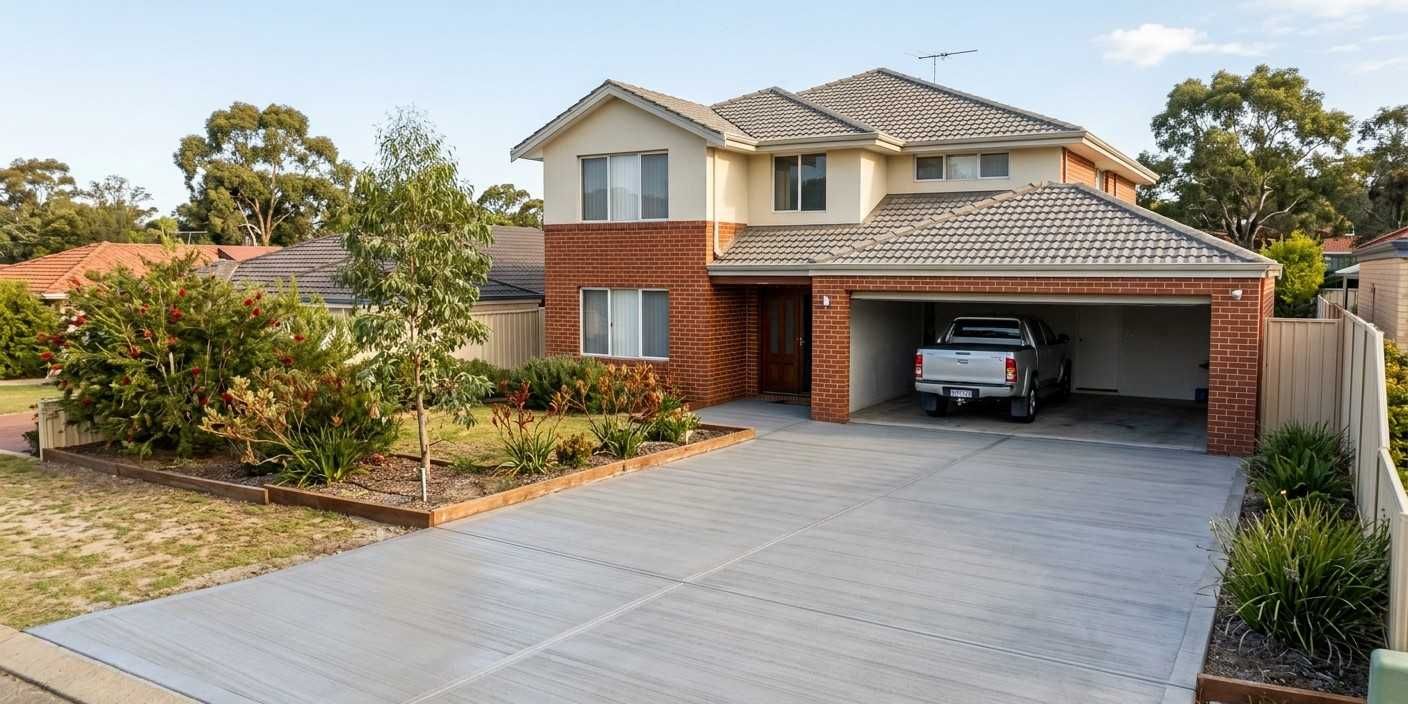
If you are coordinating multiple site improvements at once, such as building a workshop alongside your main parking area, we can simultaneously pour a heavy-duty concrete slab engineered to handle heavy equipment and machinery.
Why Base Preparation and Drainage Fall Matter
Water management is critical when pouring residential concrete in sloping terrain. When rainfall hits a large, flat concrete surface, it must flow somewhere immediately. If your driveway lacks adequate fall, water pools in low spots, creating slip hazards and degrading edge joints over time. Even worse, water running toward your house can seep beneath external doors and damage internal flooring.
Our concrete specialist team calculates fall lines across every square metre of formwork. We ensure a steady grade of at least 1:100 (1cm drop for every metre of length) toward stormwater pits, sub-surface drains, or natural garden soakwells. Getting these measurements right before the concrete pouring process starts ensures your driveway stays dry, safe, and fully functional through heavy winter rainstorms.
Frequently Asked Questions
How long do I need to wait before driving on my new concrete driveway?
You can walk on your new driveway approximately 24 to 48 hours after the pour, depending on weather conditions. However, passenger vehicles should stay off the driveway for at least 7 days while the concrete cures and reaches its structural strength. Heavy trucks or caravans should wait 28 days for full strength.
What finish provides the best grip for sloped or steep driveways?
An exposed aggregate finish or a heavy broom texture offers the best traction for sloped driveways. Exposed aggregate exposes natural stone gravel, providing a rough, slip-resistant surface that prevents vehicle tyres from slipping when the driveway is wet.
How do control joints prevent my driveway from cracking?
Concrete naturally expands and contracts as ground temperatures change. Control joints are strategically cut into the top third of the slab shortly after pouring. These cuts create planned stress points so that as the concrete shrinks during curing, any movement occurs neatly inside the joint rather than creating unsightly, random cracks across the main surface.
Can you pour a new driveway over an old, cracked one?
Pouring fresh concrete directly over a severely cracked or shifting slab is not recommended. Any movement or cracking in the old surface will transfer straight up into the new concrete layer. In most cases, breaking up and removing the old driveway to properly compact the base layer underneath yields a far better long-term result.
Other Concrete Services
Ready to upgrade your property with a long-lasting, properly graded driveway?
Call now for your free quote! Get in touch with our team today to schedule an on-site visit and discuss your project details.